The Best Home Care Agencies for Seniors in Council Bluffs, IA for 2025
Caring.com offers a free service to help families find senior care and ...
authentic reviews to help you in your decision. On average in Council Bluffs, IA, residents and their loved ones rate In Home Care agencies 4.5 out of 5 stars across the options below.
Filters
Loading...
What you can do with Caring
On this page:
- Home Care Services in Council Bluffs, Iowa
- Paying for Home Care in Council Bluffs, IA
- Financial Assistance for Home Care in Council Bluffs, IA
- Free & Low-Cost Home Care Resources in Council Bluffs, IA
- Determining Your Loved One’s Need for In-Home Care
- Guidelines for Talking About In-Home Care
- Frequently Asked Questions
Paying for Home Care in Council Bluffs, IA
The Cost of Home Care in Council Bluffs, IA
According to the Genworth 2020 Cost of Care Survey, home care services cost an average of $4,767 per month. While this average cost matches Iowa’s statewide average, it’s nearly $300 greater than the national average of $4,481 per month. Des Moines, nearly 130 miles east of Council Bluffs, is markedly more expensive, averaging $5,148 per month. Sioux City is also pricier at $5,005, as is Lincoln, Nebraska, at an average of $4,957.
Council Bluffs
$4,767
Iowa
$4,767
United States
$4,481
Des Moines
$5,148
Lincoln, NE
$4,957
Sioux City
$5,005
The Cost of Home Care vs. Other Senior Care Options in Council Bluffs, IA
Seniors living in Council Bluffs who receive home care services pay a monthly average of $4,767. Home health care, which is better suited for seniors with chronic health problems, costs $190 more per month for an average of $4,957. The cheapest option is adult day health, costing just $1,625 per month. Assisted living is cheaper than in-home care at $4,523 per month. Nursing homes are by far the most expensive option available at $8,182 per month.
Home Care
$4,767
Home Health Care
$4,957
Adult Day Health
$1,625
Assited Living
$4,523
Nursing Home Care (semiprivate room)
$8,182
Note: Data for Council Bluffs was unavailable, so data for the nearest city, Omaha, NE, was used instead.
Financial Assistance for Home Care in Council Bluffs, IA
Given the high cost of in-home care, many people use one or more forms of financial assistance to cover the expenses. Below, we explain some of the most common sources of financial help for paying for in-home care. If none of these options are available to you, you can reach out to your Area Agency on Aging or Aging and Disability Resource Center to learn about local resources.
- Long-Term Care Insurance: Long-term care insurance covers expenses related to senior care, including in-home care. Depending on the policy type, beneficiaries may receive a cash payment to use towards long-term care or reimbursement for qualifying long-term care expenses. Note that there are limitations- typically a maximum benefit of $150 per day- and exact coverage terms vary depending on the exact policy, so always check the details.
- Medicare: Medicare does not cover in-home care because it is classified as custodial, or non-medical, care. However, some Medicare Advantage and Medicare Supplement plans, which offer expanded benefits, may cover in-home custodial care.
- Medicaid: Medicaid coverage of in-home care varies between different states because it is not a federally mandated benefit. Currently, all states cover some in-home care either through their standard Medicaid or a waiver program. The specific coverage rules are set individually by each state.
- Veterans’ Benefits: The Aid and Attendance benefit is a monthly cash payment that beneficiaries can use to pay for senior care, including in-home care services. To qualify for A&A, Veterans must already receive the VA pension and meet several additional requirements, including needing assistance with the activities of daily living. Contact the Department of Veterans Affairs to learn more.
- Reverse Mortgages: Home Equity Conversion Mortgages (HECMs) are federally insured loans that are available to homeowners age 62 and over. Reverse mortgages allow you to access a portion of your home’s equity in cash, tax free. Many seniors use reverse mortgages to finance their care expenses, including in-home care. Note that although there are no monthly payments due on reverse mortgage loans, borrowers do have to repay the loan once the last surviving homeowner passes away, moves, or sells the home.
Free & Low-Cost Home Care Resources in Council Bluffs, IA
Council Bluffs’ close proximity to Omaha, Nebraska, gives local seniors access to a wealth of senior-oriented resources from nonprofit organizations and government agencies. The following free and low-cost resources help seniors save money on monthly expenses, improve the safety of their homes and pay for much-needed care services, ultimately giving seniors the freedom to age in place.
| Resource | Contact | Service |
|---|---|---|
| Benefits Enrollment Counseling | (800) 432-9209 | Connections Area Agency on Aging, acting as a Center for Benefits Access, helps seniors in Council Bluffs find public benefits, focusing on educating Medicare beneficiaries about long-term care options. Options counselors from Connections connect seniors with subsidies to help pay for in-home care. They also link seniors with helpful non-Medicare resources such as the Low-Income Home Energy Assistance Program. |
| Iowa Low-Income Home Energy Assistance Program | (712) 755-5135 | Funded wholly by federal grants, the Iowa Low-Income Home Energy Assistance Program improves energy efficiency by paying for a portion of seniors' heating and cooling bills and educating them about energy-efficient practices. The program is active all year long, reducing qualifying seniors' utility bills all 12 months of the year. LIHEAP is a sister program of LIHWAP, a similar program that pays for part of seniors' water bills. Seniors must meet income eligibility guidelines to qualify. |
| Iowa Low-Income Weatherization Assistance Program | (712) 755-5618 | The Iowa Low-Income Weatherization Assistance Program reduces seniors' energy expenditures and improves their in-home comfort by providing basic home repairs and installations. Although not exclusively for seniors, seniors who apply are given priority over all other applicants. Examples of energy-saving measures provided by the Weatherization Assistance Program include insulation installation and heating system upgrades. Provided by West Central Community Action, the program helps upward of 150 homes each year throughout its service area. |
| Health Equipment and Long-Term Planning | (402) 341-6559 | An Omaha, Nebraska-based 501(c)(3) nonprofit organization, Health Equipment and Long-Term Planning boosts the independence and quality of life of more than 7,000 seniors across southwest Iowa and eastern Nebraska with its medical equipment loans and long-term care planning services. HELP offers more than six dozen types of gently used medical equipment, including blood pressure monitors, lift chairs, bed rail cushions, compression socks and wheelchairs. |
Determining Your Loved One’s Need for In-Home Care
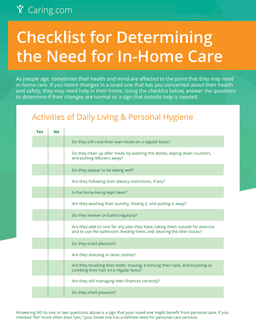
Aging can be a difficult process, and loved ones may not always ask for help – often times it’s up to their family to evaluate their need for help around the house. While no two situations are exactly alike, this checklist can help you and your loved ones determine when it’s time to start the search for a home care provider.


Guidelines for Talking About In-Home Care
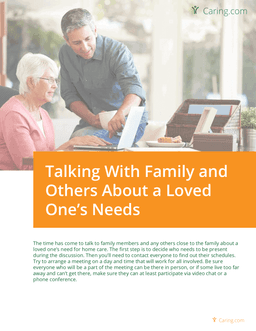
If you’ve determined that your loved one needs the assistance of a care provider in their home, it may be time for a difficult conversation. Handled correctly, however, this process can bring a family together and ensure that everyone’s concerns are addressed. Use this PDF as a starting point to help the conversation stay as positive and productive as possible.