.png&w=256&q=75)
Home Instead - Duncansville, PA
1923 Plank Rd, Duncansville, PA 16635
5.0
(6 reviews)
"caregivers are very friendly,they are always on time and do whatever needs done"
Pricing not available
Caring.com offers a free service to help families find senior care and ...
1923 Plank Rd, Duncansville, PA 16635
5.0
(6 reviews)
"caregivers are very friendly,they are always on time and do whatever needs done"
Pricing not available
2100 E College Ave, State College, PA 16801
4.9
(11 reviews)
"Home Instead has been a lifesaver. I only wish I had realized earlier that I needed help in caring for my LO with Alzheimer's. In addition to bathing, shampooing, feeding, and be a companion to my spouse, XXXXX, our caregiver gives me the opportunity to have six hours of personal time each week. XXXXX has always been on time, is professional, pleasant, and humorous. My spouse and XXXXX get along extremely well and seem to enjoy each other's company. I heartily recommend Home Instead Senior Care. "
Pricing not available

1301 9th St, Altoona, PA 16601
5.0
(1 reviews)
"Great caring staff! They are all so professional and work well as a team to make sure everyone is happy with the services. They were available to us 24 hours a day! "
Pricing not available

115 Union Avenue, Altoona, PA 16602
5.0
(1 reviews)
"We got Grane Hospice Care for my mom before she passed away, and everybody was great. They were very knowledgeable, very helpful, and they were amazing. We had people coming whenever it was needed. I can't say anything bad about them."
Pricing not available

1798 Plank Rd., Duncansville, PA 16635
Home health care services from Interim allow individuals to stay safe, independent, and engaged while remaining in their own homes. We offer: Personal Care and Support Companionship and help with daily living activities such as grooming, bathing, fixing meals, and laundry. Respite Care Respite care from Interim provides family members breaks from the daily routine of care giving. Whether it's for a few hours or a long vacation, Interim can provide the support and relief needed.
Pricing not available
1840 N. Atherton Street, State College, PA 16803
5.0
(1 reviews)
"I have a daughter that is severally handicapped and my husband passed away at a very young age, so I was left to care for 3 children 1 which was totally dependent on full time care.... With the help of the ARC of Centre Co this organization was brought in to help me with the care of my daughter and was the biggest blessing I could ever have, I don't know what I would of ever done without them....I was blessed with the most incredible loving and wonderful women I have ever met in my life who was a GOD send. I would recommend them to anyone... "
Pricing not available
Caring's Family Advisors are here to help you with questions about senior living and care options.

1350 South Atherton Street, State College, PA 16801
4.5
(107 reviews)
Pricing not available

106 Clara Street Suite 5, Ebensburg, PA 15931
5.0
(1 reviews)
"I lived about four hours from my parents during the time my dad was starting to need some extra help to care for his medical needs. As senior citizens in their 80s, my parents were of sound mind, but had some difficulty getting around. Although I was able to visit on the weekends, I needed to find someone to come in during the week and make sure they were taking their meds and following doctor's orders. I interviewed several independent care providers, but felt uncomfortable because they were not bonded or insured. So I looked toward the agencies that serviced my parents' community. I selected Comfort Keepers, operating out of Clearfield, Pennsylvania. They are a national chain and they specialize in helping senior citizens. They allowed me to interview as many CNAs as I wanted until I found the right person for the job. However, I interviewed three young ladies and each one they sent would have been perfectly suitable. I was very comfortable with every candidate they sent. Each one showed up on time, was neat and clean, answered every one of my questions thoroughly and assured me that they would give my dad the highest quality of care. More importantly, each one of them got along well with my dad (very important), so that made me happy. It was a tough decision, but I went with the one caregiver who lived the closest to my dad, thinking that it would be easier in bad weather for someone close by to drive for the visit. Her name was Rhonda, and she was excellent. Although I only asked for her to come three times a week for 3-4 hours a day, this exceptional young woman would stop by on off days just to "say hello" and check in. This went above and beyond anything I would have hoped for. Rhonda monitored my dad's meds, changed dressings, helped him bathe and even made him some snacks. For the six months that I had her working, she became a member of the family, even bringing her dog and her little nephew on some of her off-day visits. I think that Comfort Keepers is an excellent franchise and I was so pleased with their service. Although their rates are not cheap (but they are competitive), they do know how to deal with the senior population. I never had a problem with Rhonda showing up late or not showing up at all. She was on time and she kept in touch with me by e-mail or phone, to let me know how my dad was doing. More importantly, my dad loved Rhonda, and he would listen to her advice before he would listen to mine. That was certainly OK with me. There came a point where my dad no longer needed in-home care and we were sorry to have to stop the service. But Rhonda continued to stop by whenever she was in the area and became a good family friend. I suspect this was an unusual circumstance, but I think it is why I am so pleased to recommend Comfort Keepers as a home care provider for seniors. "
Pricing not available
Home care costs $4,290 per month in Tyrone, according to reporting from Genworth’s 2021 Cost of Care Survey. The Pennsylvania monthly average is $4,957, which happens to be identical to the U.S. average. Johnstown, where the price for home care is $3,813 a month, is the only Pennsylvania city with lower costs than Tyrone. Prices reach their highest in Pennsylvania’s largest cities: Pittsburgh’s monthly fees are $5,339, and Philadelphia’s costs are slightly lower at $5,329.
Tyrone
$4,290
Pennsylvania
$4,597
The United States
$4,957
Pittsburgh
$5,339
Johnstown
$3,813
Philadelphia
$5,329
Other long-term care options for seniors include home health care. Though this kind of care usually involves more complex medical support than regular home care, both types are priced identically at $4,290 per month. Assisted living care is slightly cheaper than home care at $4,030 per month. A semiprivate room in a nursing home is the most expensive option at $9,946, just barely under five digits. Adult day health care is cheaper than other options at $1,625 a month.
Home Care
$4,290
Home Health Care
$4,290
Adult Day Health Care
$1,625
Assisted Living Facility
$4,030
Nursing Home Facility (semiprivate room)
$9,946
Note: Data for Tyrone was unavailable, so data for the nearest city, Altoona, was used instead.
Given the high cost of in-home care, many people use one or more forms of financial assistance to cover the expenses. Below, we explain some of the most common sources of financial help for paying for in-home care. If none of these options are available to you, you can reach out to your Area Agency on Aging or Aging and Disability Resource Center to learn about local resources.
Resources in the following chart help Tyrone and Blair County seniors with home repairs and upgrades, transportation services, and socialization opportunities. Local and state governments also offer tax exemptions to some homeowners, helping cut down on the costs of aging in place.
| Resource | Contact | Service |
|---|---|---|
| Blair County Area Agency on Aging | (814) 946-1235 | Based in nearby Altoona, this local office functions as a clearinghouse for older-adult resources. Seniors can access volunteer income tax assistance, take no-cost exercise classes and sign up for low-cost adult day care and short-term respite care services. The agency also makes free curb-to-curb transportation available for most county residents over 65 through its Find a Ride program. |
| Heating Assistance/ Low-Income Home Energy Assistance Program | (814) 946-7365 | This program provides one-time grants of $500 to $1,500 that help low-income homeowners and renters pay for heating costs. Payments are made directly to the heating vendor for simplicity. In addition to the one-time cash benefits, some residents may receive crisis grants in case of a broken HVAC system, loss of fuel or impending service termination. |
| Blair County Community Action Program | (814) 946-3651 | Tyrone residents can access the state's Weatherization Assistance Program through this service. This program helps homeowners reduce their electric and gas bills by installing energy-efficient home upgrades, such as air-sealed doors, updated heating systems and new attic and wall insulation. It prioritizes low-income seniors when examining applications; the program provides an average of $7,669 in home upgrades. |
| Homestead Tax Exemption | (814) 693-3110 | This exemption allows most county residents to apply for the exclusion of property taxes on their primary residence. Interested seniors must file by March 1 to receive the exemption for that tax year. |
Aging can be a difficult process, and loved ones may not always ask for help – oftentimes it’s up to their family to evaluate their need for help around the house. While no two situations are exactly alike, this checklist can help you and your loved ones determine when it’s time to start the search for a home care provider.
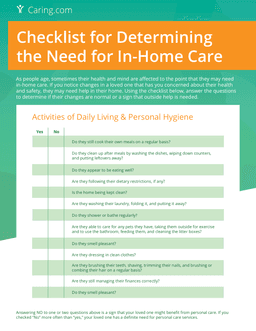
If you’ve determined that your loved one needs the assistance of a care provider in their home, it may be time for a difficult conversation. Handled correctly, however, this process can bring a family together and ensure that everyone’s concerns are addressed. Use this PDF as a starting point to help the conversation stay as positive and productive as possible.