The Best Home Care Agencies for Seniors in Tulare, CA for 2025
Caring.com offers a free service to help families find senior care and ...
authentic reviews to help you in your decision. On average in Tulare, CA, residents and their loved ones rate In Home Care agencies 5.0 out of 5 stars across the options below.
Filters
Loading...
What you can do with Caring
On this page:
Paying for Home Care in Tulare, CA
The Cost of Home Care in Tulare, CA
The Genworth 2020 Cost of Care Survey shows that the cost of home care in Tulare is $286 higher than the U.S. median of $4,481 and $762 lower than the California median cost. Compared to the neighboring city of Bakersfield which has an average home care price of $5,077, Tulare is more affordable. Tulare also has a significantly lower price for home care than Fresno, where agencies charge on average $5,034.
Tulare
$4,767
California
$5,529
United States
$4,481
Fresno
$5,034
Bakersfield
$5,077
Santa Maria
$6,101
The Cost of Home Care vs. Other Senior Care Options in Tulare, CA
Seniors in Tulare have access to various types of care options depending on what they require. The most affordable option available to seniors is adult day health care with a median cost of $1,192. The cost of home care is $4,767 compared to home health care, which includes medical services and care from registered nurses or therapists, and costs on average $4,805. To live in an assisted living facility typically costs less than home care at $4,548 monthly, and staying in a nursing care facility costs significantly more at $6,844 for a semiprivate room.
Home Care
$4,767
Home Health Care
$4,805
Adult Day Health
$1,192
Assisted Living
$4,548
Nursing Home Care (semiprivate room)
$6,844
Note: Data for Tulare was unavailable, so data for the nearest city, Visalia, was used instead.
Financial Assistance for Home Care in Tulare, CA
Given the high cost of in-home care, many people use one or more forms of financial assistance to cover the expenses. Below, we explain some of the most common sources of financial help for paying for in-home care. If none of these options are available to you, you can reach out to your Area Agency on Aging or Aging and Disability Resource Center to learn about local resources.
Long-Term Care Insurance: Long-Term Care Insurance covers expenses related to senior care, including in-home care. Depending on the policy type, beneficiaries may receive a cash payment to use towards long-term care or reimbursement for qualifying long-term care expenses. Note that there are limitations- typically a maximum benefit of $150 per day- and exact coverage terms vary depending on the exact policy, so always check the details.
Medicare: Medicare does not cover in-home care because it is classified as custodial, or non-medical, care. However, some Medicare Advantage and Medicare Supplement plans, which offer expanded benefits, may cover in-home custodial care.
Medicaid: Medicaid coverage of in-home care varies between different states because it is not a federally mandated benefit. Currently, all states cover some in-home care either through their standard Medicaid or a waiver program. The specific coverage rules are set individually by each state.
Veterans’ Benefits: The Aid and Attendance benefit is a monthly cash payment that beneficiaries can use to pay for senior care, including in-home care services. To qualify for A&A, Veterans must already receive the VA pension and meet several additional requirements, including needing assistance with the activities of daily living.Contact the Department of Veterans Affairs to learn more.
Reverse Mortgages: Home Equity Conversion Mortgages (HECMs) are federally insured loans that are available to homeowners age 62 and over. Reverse mortgages allow you to access a portion of your home’s equity in cash, tax free. Many seniors use reverse mortgages to finance their care expenses, including in-home care. Note that although there are no monthly payments due on reverse mortgage loans, borrowers do have to repay the loan once the last surviving homeowner passes away, moves, or sells the home.
Free & Low-Cost Home Care Resources in Tulare, CA
There are a variety of low-cost and free programs in Tulare to help seniors age in place. There are local and federal assistance programs available that can help with financial assistance and general wellbeing. Families can learn more by contacting the agencies below.
| Resource | Contact | Service |
|---|---|---|
| Meals on Wheels | (559) 685-2330 | The goal of Meals on Wheels is to provide nutritious meals to homebound seniors in Tulare to allow them to live independently. It provides a temporary or permanent service for seniors over the age of 60 who cannot prepare meals due to chronic illness or old age. |
| Weatherization Assistance Program | (844) 224-1316 | The Weatherization Assistance Program is a federally funded program that helps low-income seniors with home improvements to increase the energy efficiency of their homes. To be eligible, seniors must have a max gross monthly income of no more than $2,431 for a one-person household. The types of services available include ceiling insulation, window replacement and weather stripping exterior doors. |
| California Low Income Home Energy Assistance Program | (866) 675-6623 | The Low Income Home Energy Assistance Program (LIHEAP) is funded by the Federal Department of Health and Human Services. It provides low-income individuals with financial assistance for energy bills. To be eligible for the program, applicants must meet household size and income limits. Successful applicants can get a discount or a payment sent directly to their electricity, gas or telephone bill provider. |
| Medicare Counseling (HICAP) | (800) 434-0222 | The Medicare Counseling program provides seniors with unbiased help with navigating Medicare. Seniors receive unique one-to-one guidance from a counselor that is specific to their situation and needs. Some of the services they can provide include how to enroll, plan comparison and troubleshooting billing issues. It's a national program that's federally funded. |
Determining Your Loved One’s Need for In-Home Care
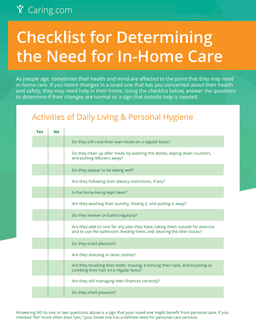
Aging can be a difficult process, and loved ones may not always ask for help – oftentimes it’s up to their family to evaluate their need for help around the house. While no two situations are exactly alike, this checklist can help you and your loved ones determine when it’s time to start the search for a home care provider.


Guidelines for Talking About In-Home Care
If you’ve determined that your loved one needs the assistance of a care provider in their home, it may be time for a difficult conversation. Handled correctly, however, this process can bring a family together and ensure that everyone’s concerns are addressed. Use this PDF as a starting point to help the conversation stay as positive and productive as possible.